#Reporting
Tumour budding is already counted in colorectal cancer. A study by the authors in Finland asked whether the distance of buds from the tumour bulk adds prognostic information beyond those counts. They reported the work in Virchows Archiv, March 2026.
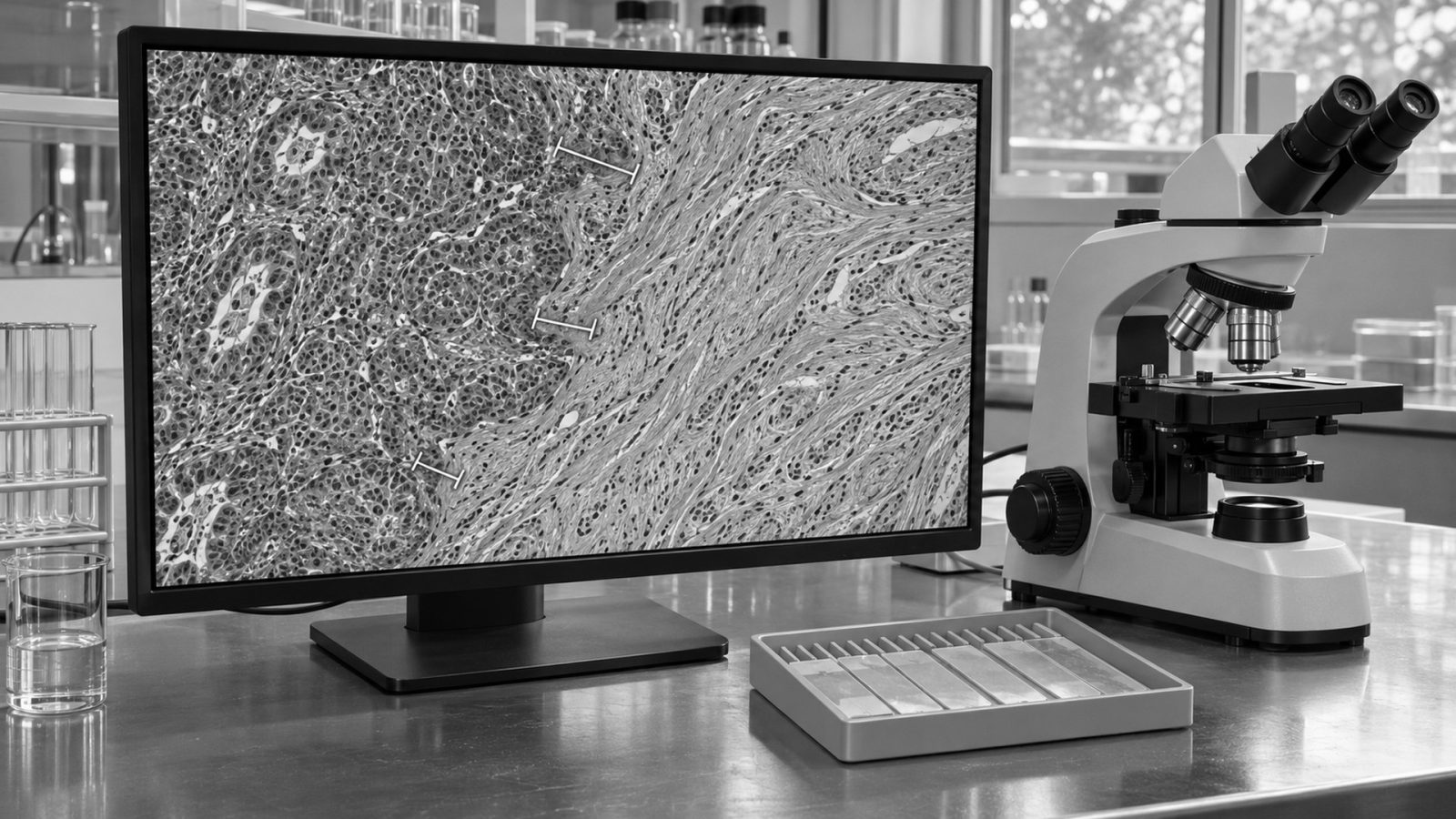
The measure, called TB-distance, is the mean distance from the tumour bulk to the three farthest tumour buds. It is measured digitally on H&E whole-slide images, from the edge of each bud to the nearest edge of the tumour bulk. If fewer than three buds are present, the available distances are still divided by three. The authors say this reduces the influence of a single unusually distant bud.
Conventional budding was scored on H&E whole-slide images in a 0.785 square millimetre hotspot. Grade 1 means fewer than 5 buds, grade 2 means 5 to 9 buds and grade 3 means 10 or more buds. Buds were single tumour cells or clusters of up to four cells, in line with the international consensus method for counting buds.
The study used two retrospective surgical cohorts. Cohort 1 had 1,011 individuals operated on from 2006 to 2020, and Cohort 2 had 1,343 patients operated on from 2000 to 2015. Patients who had neoadjuvant treatment were excluded (235 and 243). That left 776 and 1,100 for histopathological evaluation, 1,876 cases in all, and 771 and 1,063 for survival analyses.
The cut-off of 123 micrometres was derived by receiver operating characteristic analysis for 10-year cancer-specific survival in Cohort 1. It was then applied unchanged to Cohort 2. The area under the curve was 0.63 (95% CI 0.58 to 0.68) for the mean of the three farthest buds and 0.62 (95% CI 0.57 to 0.67) for the single farthest bud.
High TB-distance was present in 209 (27%) tumours in Cohort 1 and 199 (18%) in Cohort 2. In both cohorts it was associated with high grade, advanced stage, lymphovascular invasion, high conventional budding grade and mismatch-repair-proficient status (p < 0.003 for all). To illustrate the budding categories, high TB-distance was found in 95 (90%) of grade 3 budding tumours in Cohort 1 and 93 (79%) in Cohort 2. For grade 1 tumours the figures were 38 (7.0%) and 31 (3.7%).
Survival results were adjusted for age, sex, year of operation, tumour location, stage, grade, lymphovascular invasion, mismatch repair status and BRAF status. For cancer-specific survival, the multivariable hazard ratio was 1.47 (95% CI 1.04 to 2.09, p = 0.030) in Cohort 1 and 1.34 (95% CI 1.04 to 1.74, p = 0.026) in Cohort 2.
For overall survival, the multivariable hazard ratio was 1.37 (95% CI 1.04 to 1.81, p = 0.027) in Cohort 1 and 1.22 (95% CI 0.99 to 1.50, p = 0.067) in Cohort 2. The Cohort 2 result was not significant. The text and abstract put the weight on cancer-specific survival.
Within conventional budding grades, associations were not statistically significant in most analyses. One nominal association appeared in budding grade 1 in Cohort 2 (hazard ratio 1.86, 95% CI 1.01 to 3.42, p = 0.047), but it did not hold in the multivariable model (hazard ratio 1.61, 95% CI 0.86 to 3.04, p = 0.14). When both variables were placed in the same regression model, conventional budding stayed associated with outcome, whereas TB-distance gave no additional prognostic information.
Two observers assessed 30 cases. The correlation coefficient was 0.58 for the continuous measure and the kappa statistic was 0.43 for the binary classification, which the authors call moderate agreement.
The authors conclude that high TB-distance is associated with aggressive tumour morphology and worse outcome, but does not improve prognostication beyond standard bud assessment. They suggest that widely dispersed buds may serve as a simple visual prompt to re-scan the invasive front for a higher-density budding hotspot. They also suggest that TB-distance may be a quantifiable spatial feature for computational pathology.
#Interpretation
The Cohort 1 result is optimistic, because the cut-off was derived on that cohort's own 10-year cancer-specific survival. Cohort 2 is the validation. There the cancer-specific survival hazard ratio of 1.34 has a lower bound of 1.04, and the overall survival result was not significant.
TB-distance tracks conventional budding, as the category figures above show. The authors acknowledge collinearity, so it adds little once bud counts are in the model. As an editorial reading, because the sum is divided by three, tumours with few buds score low by construction. That alone would make the measure follow bud number.
The plausible uses are a visual prompt for hotspot re-scanning or a feature for automated analysis. The paper tests no workflow, no turnaround and no pathologist reading.
For laboratories in India and elsewhere, bud counting on routine H&E is already the practical step. A distance measure needs scanned slides and measuring tools that not every laboratory has, and any use would need local validation.
#Opinion
This is a clear question, tested in two sizeable cohorts, with an honest negative result. That is useful, because it stops a plausible-sounding metric from being added to reports without evidence.
There are reasons for caution. The cut-off was set on one cohort, the validation hazard ratio is modest, and agreement between observers was only moderate. Whether the metric is new cannot be judged here.
#Limits
- The study is retrospective and uses two cohorts from one country.
- Measurement depends on the observer, with moderate agreement from only 30 cases.
- Excluding patients who had neoadjuvant therapy limits generalisability, particularly to rectal cancer and other pretreated tumours.
- TB-distance is collinear with conventional budding.
- The cut-off was derived on Cohort 1.
- Overall survival was not significant in Cohort 2.
- The budding-adjusted comparison is reported only in supplementary material, which the text does not quantify.
- Data are not publicly available.
This briefing summarises one study and gives no advice on patient management.
Frequently asked questions
What is TB-distance?
TB-distance is the mean distance from the tumour bulk to the three farthest tumour buds, measured digitally on H&E whole-slide images. It runs from the edge of each bud to the nearest edge of the bulk. If fewer than three buds exist, the distances are still divided by three.
Does TB-distance improve prognosis beyond bud counts?
No, the authors found it did not improve prognostication beyond standard bud assessment. With both variables in the same regression model, conventional budding stayed associated with outcome and TB-distance did not. The Cohort 2 overall survival result was also not significant (hazard ratio 1.22, p = 0.067).
Could laboratories use it in routine reporting now?
The study does not support adding it to routine reports. Agreement between two observers was only moderate (kappa statistic 0.43 in 30 cases), and the paper tests no workflow. Distance measurement also needs scanned slides and measuring tools, so any use would need local validation.
Source
https://doi.org/10.1007/s00428-026-04471-9 ↗For education and professional reference. This does not give patient-specific advice or replace professional judgement, local protocols or consultation. Editorial standards.