
#Reporting
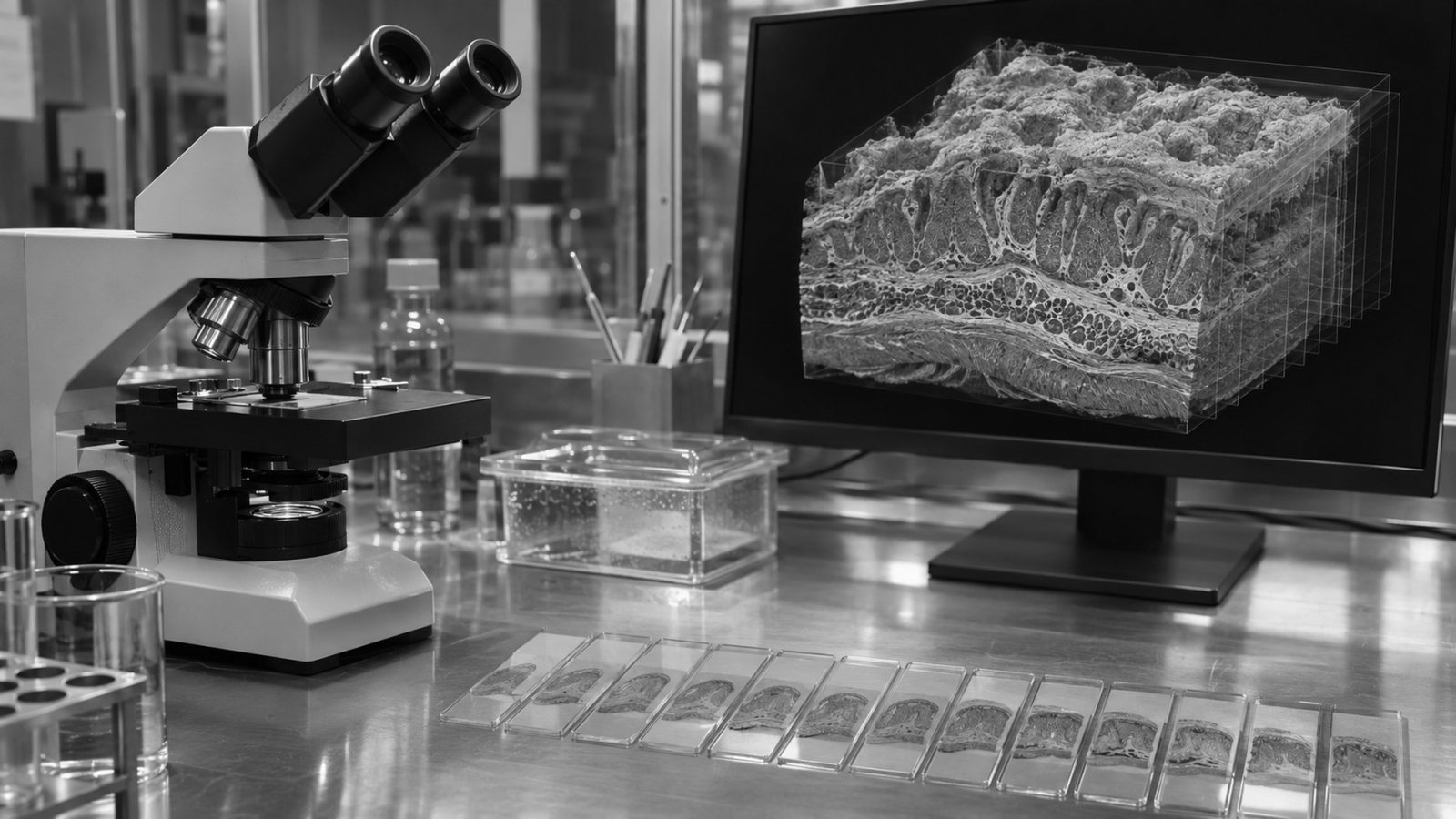
Spatial biology maps molecular expression and cellular relationships within tissue. Three-dimensional (3D) pathology visualises tissue architecture as a volume, extending what thin sections can show.
Wang et al. reported a cross-sectional, self-administered online survey in iMeta, 4 November 2026. Its 239 respondents formed an Asia-enriched convenience sample. An international multidisciplinary panel developed the questionnaire and interpreted findings, including people with current or previous roles in the Asian Society of Digital Pathology (ASDP) and the European Society of Digital and Integrative Pathology (ESDIP).
Asia accounted for 73.2% of respondents, with mainland China contributing 25.1%, Singapore 14.6% and India 9.6%. Pathologists were the largest professional group, at 44.8%.
Self-rated domain scores of 3 or higher defined higher experience. Respondents were grouped as spatial biology experts, 3D pathology experts, dual-domain experts or non-experts, depending on whether they met that threshold in either, both or neither domain. These operational labels were not independently validated expertise assessments.
Regular spatial transcriptomics use was reported by 41 of 239 respondents (17.2%): 42.9% of dual-domain experts and 32.6% of spatial biology experts, compared with 1.6% of non-experts. Regular or occasional 3D imaging use was reported by 55 of 239 (23.0%). Missing feedback was retained in denominators and did not establish non-use.
The most reported 3D approaches were serial section-based reconstruction (32.6%), light-sheet microscopy (21.8%) and 3D immunohistochemistry or multiplex imaging (16.3%). Respondents also reported familiarity with or use of commercial spatial transcriptomic platforms.
Shared barriers included cost, complex data analysis, limited standardisation, sample preparation, restricted access and insufficient expertise or training. For spatial transcriptomics, technology or reagent costs led with 140 responses, followed by complex data analysis and integration with 88.
For clinical adoption within a decade, 28.9% were confident, 26.4% unsure, 31.4% pessimistic and 13.4% gave no feedback. These were expectations, not forecasts.
#Interpretation
The survey is consistent with an implementation gap in routine diagnostic settings, where non-experts predominated among hospital respondents. It does not establish that most routine diagnostic departments are using these methods, or quantify uptake across departments. For a department in India considering them, the reported obstacles extend beyond acquiring equipment to analytical support, sample workflows and interdisciplinary training.
Formalin-fixed paraffin-embedded (FFPE) compatibility is increasingly platform- and assay-specific. Fixation-related RNA damage, variable preservation, background and transcript assignment still matter. Compatibility with archival material does not by itself establish a clinically validated workflow.
Cell segmentation and spatial registration remain difficult. Overlapping cells can impair boundary detection and transcript assignment; depth-related signal loss, deformation and registration errors can distort 3D reconstruction. The paper lists several segmentation methods as technical context, without testing their effect on implementation.
The authors caution that large datasets can still underrepresent populations and laboratories. Validation in Western cohorts may not ensure comparable performance in Asian populations. They call for diverse datasets, subgroup evaluation and external validation, alongside governance addressing privacy, security, interoperability, consent-linked restrictions and secondary use. Controlled access, encryption and auditability are among the options discussed.
#Limits and disclosures
Convenience sampling and open-network recruitment prevented a conventional response-rate estimate. Early and late respondents differed in professional role and self-rated experience, suggesting possible non-response bias that these comparisons cannot quantify or exclude.
Experience was self-rated, professional composition was unequal and the 3D pathology expert subgroup was small (n = 9). Asia enrichment limits generalisability. Few respondents worked in government agencies, and regulators were not specifically targeted. Selective non-response may also affect the confidence comparisons.
Comparisons were unadjusted and cannot isolate an independent contribution of experience to implementation or establish which came first. The survey describes reported use and expectations, rather than forecasts. The authors declared no conflicts of interest; support came from public research and government grants.
#Opinion
Pathologist's Brief considers workflow readiness a more useful departmental starting point than enthusiasm for a particular modality. A proposal should make its analytical support, local validation and data governance as explicit as its tissue preparation requirements.
Frequently asked questions
Do the survey expert labels indicate accredited expertise?
No, the labels describe self-rated domain experience rather than accredited or independently validated expertise. Scores at the stated threshold separated respondents into operational groups across spatial biology and 3D pathology. Their reported use also varied with professional composition, and unadjusted comparisons cannot isolate experience as the explanation.
Does FFPE compatibility remove the main technical obstacles?
No, FFPE compatibility leaves important analytical and tissue-related obstacles unresolved. Compatibility depends increasingly on the platform and assay, while fixation-related RNA damage and variable preservation can affect results. Cell boundaries, transcript assignment and spatial registration still need attention before compatibility can be translated into a clinically validated workflow.
Can these results estimate adoption across Indian laboratories?
No, this convenience sample cannot estimate adoption across Indian laboratories. India contributed respondents, but recruitment was not designed to represent the wider professional population. The findings identify reported barriers and differences between self-rated experience groups, with Asia enrichment, unequal professional composition and possible non-response bias limiting generalisability.
Source
https://doi.org/10.1002/imt2.70187 ↗For education and professional reference. This does not give patient-specific advice or replace professional judgement, local protocols or consultation. Editorial standards.