
On this page
#Why teach error management in pathology?
A specimen mix-up gives trainees a concrete problem to investigate. They can ask what information they need, where the process broke down and which changes might prevent a recurrence. Khorsandi et al. incorporated this kind of practice into a curriculum at a single pathology residency programme in the United States. Academic Pathology, March 2026
#What the programme did
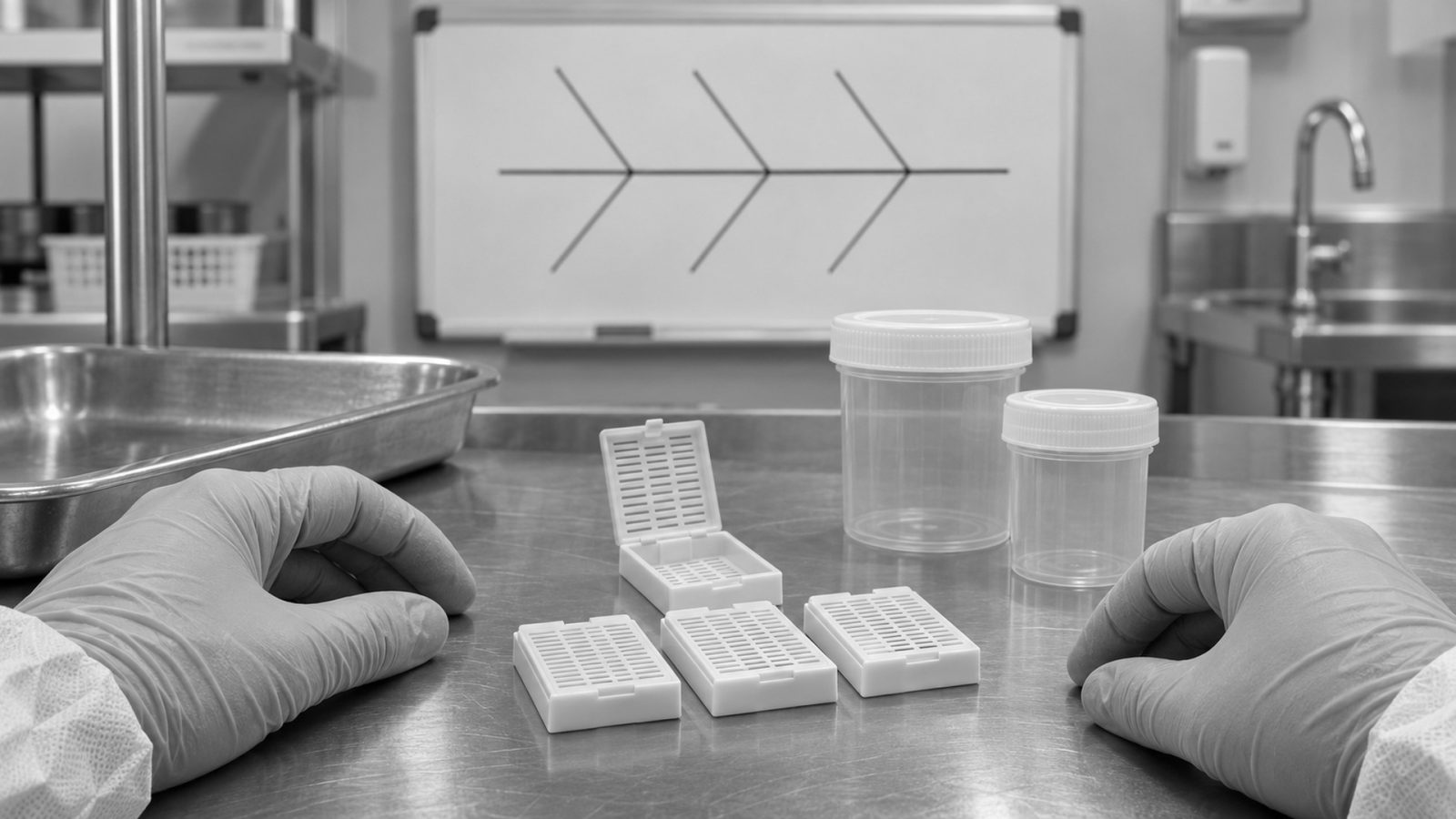
The programme invited 46 trainees to take part in 2021 to 2022. A 90-minute lecture introduced quality improvement and patient safety. In a 90-minute virtual small-group session, trainees used a fishbone diagram to organise possible causes of a specimen mix-up in the gross room. They also practised a structured handoff for outstanding surgical pathology cases at the end of a rotation.
The programme sent four monthly error cases that trainees could work through in their own time. Each set posed questions based on a real departmental error that had been adapted and anonymised for teaching. The team sent answers and explanations to all trainees after reviewing the responses.
#What the surveys showed
The anonymous surveys drew responses from 32 of 46 trainees (70%) before the curriculum and 27 of 46 (59%) afterwards. The lecture or small-group session drew 26 trainees (57%), and response rates for the monthly cases ranged from 26% to 39%. Of those who completed the post-survey, 14 met the study definition of participation and 13 fell short of it. The definition required taking part in the lecture or small-group teaching and responding to at least one monthly case.
Before the curriculum, trainees agreed most strongly that quality improvement methods can help change a system (mean 4.28). Agreement was lowest for having applied those methods during training (2.88). Trainees who reported prior training rated their confidence higher for understanding root causes (4.36 versus 3.39) and using root cause analysis tools (3.93 versus 2.61).
Compared with the pooled pre-survey, post-survey participants gave higher mean ratings for valuing quality improvement and patient safety training (4.00 to 4.64), having applied the methods (2.88 to 3.71), using root cause analysis tools (3.19 to 4.00) and designing an intervention (3.03 to 3.86). The non-participant group showed no statistically significant differences from the pooled pre-survey, although its mean rating for having applied the methods also rose to 3.54.
In a national annual resident survey, 84% of the residents responding from the programme in 2023 reported taking part in a safety-event investigation, up from 48% the year before. The authors acknowledged that this could reflect other activities.
#What the study cannot show
The researchers compared each post-survey group with the same pooled pre-survey and never compared participants directly with non-participants. A statistically significant result in one group and no significant result in the other cannot establish that the curriculum caused a difference. Some non-participants may have completed parts of the curriculum.
The surveys were anonymous and unpaired, with 13 to 14 people per post-survey group. Self-selection and non-response limit what can be inferred, and the researchers made many comparisons without a statistical correction. The study measured self-rated confidence and attitudes and relied on trainees to report whether they had applied the methods. It did not measure competence or laboratory error rates.
The abstract describes an improvement in confidence, but the finding applies only to some items. Ratings for understanding quality issues, identifying quality gaps and understanding root causes showed no significant change. The change in the national annual resident survey cannot be tied to this cohort.
The authors also identified limits to generalisability. The curriculum took two residents and three faculty members to design, participation varied across activities, and the teaching omitted clinical pathology topics.
#Adapting the approach
Pathology educators and laboratory quality leads in India and elsewhere can turn anonymised local errors into short cases with a few focused questions. Ask trainees to list the information they would need, map contributing factors on a fishbone diagram and propose a change to the process. Share the explanations with the whole group so trainees can review the reasoning.
Set aside protected time for small-group discussion and for working through the cases. Include examples from clinical pathology alongside the anatomic pathology cases so trainees can practise applying the same methods in both settings.
Frequently asked questions
What did trainees do with the fishbone diagram?
They used it to organise possible causes of a specimen mix-up in the gross room. The exercise took place in a virtual small group and gave trainees a chance to practise root cause analysis. The session also included a structured handoff exercise for outstanding surgical pathology cases.
Did the curriculum make trainees better at investigating errors?
The study did not establish whether trainees became better at investigating errors. Participants reported greater confidence in using root cause analysis tools than the pooled group had reported before the curriculum. The surveys captured perceptions, and the researchers did not directly compare the post-survey groups or assess competence.
How could our department develop its own error cases?
Start with real local errors and anonymise the details before turning them into short teaching cases. Use focused questions to prompt trainees to gather information, identify contributing factors and propose a process change. Include clinical pathology examples, give trainees time to work through them and share explanations afterwards.
Source
https://doi.org/10.1016/j.acpath.2026.100245 ↗For education and professional reference. This does not give patient-specific advice or replace professional judgement, local protocols or consultation. Editorial standards.