

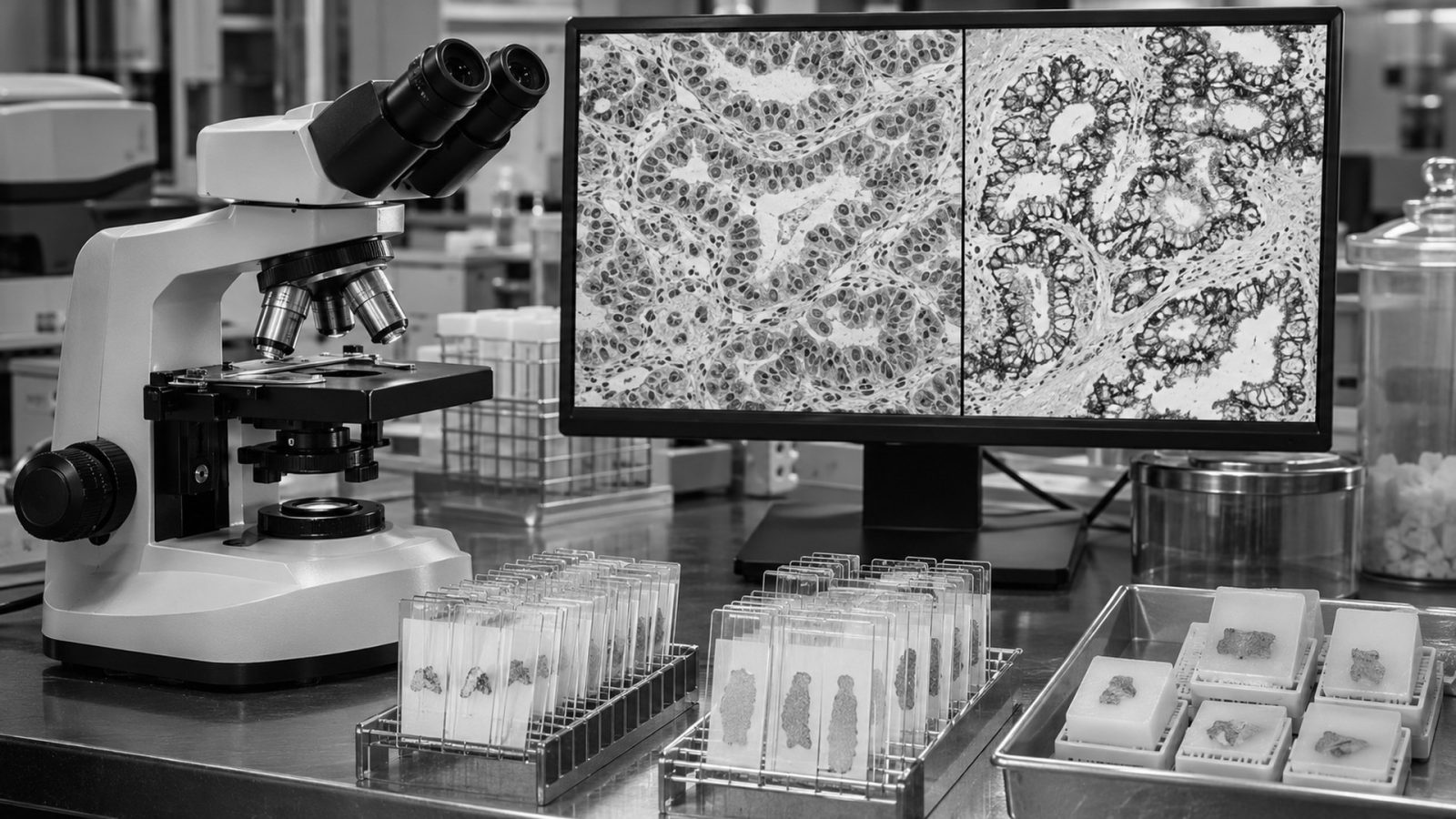
What does the evidence suggest about reading c-MET, HER2 and PD-L1 cell-block IHC like surgical specimens, and which preparation and scoring steps should the laboratory review?
Reveal the discussion
This is a fictional teaching scenario.
#Scenario
Oncologists ask a cytopathology laboratory why lung cancer cytology cell blocks seem to produce more strong c-MET and high PD-L1 results than biopsies and resections. The laboratory also uses cell blocks for HER2 predictive immunohistochemistry (IHC).
Needle rinses are collected in a culture medium, and the laboratory adds an alcohol step before formalin fixation. The team asks whether its cell-block results can be read in the same way as results on surgical formalin-fixed, paraffin-embedded (FFPE) tissue, and which preparation and scoring steps need review.
#Discussion
#What the study compared
Geetha et al. retrospectively compared non-small cell lung carcinoma cytology and surgical specimens from a single institution, collected between January 2019 and June 2025. Cytology needle rinses were collected in a tissue culture medium; effusions were collected without transport medium.
Cytology samples were centrifuged with equal volumes of ethanol and formalin before routine formalin fixation and paraffin embedding. The stated fixation procedure was 6 to 72 hours. Surgical specimens were fixed directly in formalin, without the cytology prefixation step.
The detailed results report 424 cases, comprising 212 cytology and 212 surgical specimens. The surgical group included 127 core-needle biopsies and 85 resections. Not every specimen underwent every biomarker test.
#The detailed results
Table 2 reports c-MET testing in 161 cytology and 146 surgical specimens. Strong c-MET 3+ staining occurred in 19% versus 10%, respectively. PD-L1 testing involved 190 cytology and 183 surgical specimens; high expression, a tumour proportion score of at least 50%, occurred in 32% versus 20%.
HER2 testing involved 175 cytology and 193 surgical specimens. HER2 3+ occurred in 4% versus 2%, with too few strongly positive cases for statistical comparison. The authors found significant differences for strong c-MET and high PD-L1, while HER2 findings were largely concordant.
The abstract reports 414 cases and c-MET 3+ in 40% versus 10%, which conflicts with the detailed results and Table 2 used here.
#Preparation effects and sampling biology
The authors discuss collection media and alcohol prefixation as possible influences on antigen preservation, staining intensity and interpretation. Cell-block preparation can add further variability through its effects on cellular architecture and protein accessibility. The direction of an effect depends on the marker and preparation; this study does not prove that alcohol caused the higher scores.
Fixation windows and slide storage also matter. The discussion gives approximate fixation windows of 6 to 72 hours for c-MET and 12 to 72 hours for PD-L1, with less than 3 hours suboptimal for PD-L1. These are biomarker-specific recommendations discussed by the authors, not measured fixation times for individual study specimens.
The cited slide-storage recommendations also differ: c-MET slides at 2 to 8°C for use within 45 days; PD-L1 slides at 2 to 8°C or 25°C for up to 6 months; and HER2 slides at 15 to 25°C for up to 2 years. For cytology predictive IHC, the American Society of Cytopathology recommends using unstained slides within 3 months when stored at room temperature.
Sampling biology is another explanation. Cytology came mostly from lymph nodes, whereas surgical specimens more often sampled primary lung tumours. The authors note spatial and temporal PD-L1 heterogeneity, so different sites and disease stages may contribute to the observed difference.
#Scoring and study limits
Re-review using strict interpretation guidelines changed scores in 32.5% of cases. c-MET had the most changes and tended to be over-scored initially. Downgrading originally strong c-MET results made 33 patients ineligible under the study's targeted-therapy eligibility criteria. This is an observed consequence of score revision, not a treatment recommendation.
The retrospective design allows selection bias and limits control over preanalytical variables. Specimens were not consistently matched from the same patient or tumour site, limiting direct concordance assessment. Fixation times, slide age and storage conditions were not collected. Semiquantitative scoring was subject to interobserver and intraobserver variation, particularly where intensity contributed to interpretation.
One author reported advisory fees from a pharmaceutical company outside the submitted work; the others disclosed no conflicts.
#Takeaway
The laboratory should not assume that cell-block predictive IHC behaves identically to surgical FFPE testing, particularly for intensity-based markers such as c-MET. PD-L1 scoring does not depend on staining intensity, but its observed distribution also differed. This study cannot separate technical preparation effects from sampling biology.
Validate predictive IHC specifically for the cytology preparation in use. Consider direct collection into formalin, as suggested by the American Society of Cytopathology task force, and use controls processed in the same way as the test cytology material.
Record fixation time and slide age, and review storage conditions against biomarker-specific requirements. Train readers and re-check scoring against interpretation guidelines, supported by internal quality checks and proficiency testing. These steps address both preparation and interpretation without assuming that every higher cell-block result is technical artefact.
#Source
Geetha et al., Cancer Cytopathology, 9 October 2026, study of preanalytical variables and predictive IHC in non-small cell lung carcinoma cytology specimens.
Frequently asked questions
Does formalin fixation make a cell block equivalent to a surgical block?
No, formalin fixation does not erase differences in earlier specimen handling. Collection medium, alcohol prefixation and cell-block preparation can influence antigen preservation and staining even when later processing resembles surgical FFPE workflows. The laboratory therefore needs validation for its actual cytology preparation and controls processed in the same way.
Did this study prove that alcohol caused stronger staining?
No, the study could not isolate alcohol prefixation as the cause. The retrospective groups differed in sampling sites and were not consistently paired within patients, while individual fixation and storage information was unavailable. Technical effects and biological heterogeneity therefore remain possible contributors to the different biomarker distributions.
Why should the laboratory review scoring as well as specimen preparation?
Score revision showed that interpretation itself contributed to variability. Re-review against strict guidelines changed results, with c-MET particularly prone to initial over-scoring. Markers that incorporate intensity need careful reader training, while internal review and interpretation proficiency testing can support consistency alongside the separate work of validating specimen preparation.
Source
https://doi.org/10.1002/cncy.70160 ↗For education and professional reference. This does not give patient-specific advice or replace professional judgement, local protocols or consultation. Editorial standards.


