#Reporting
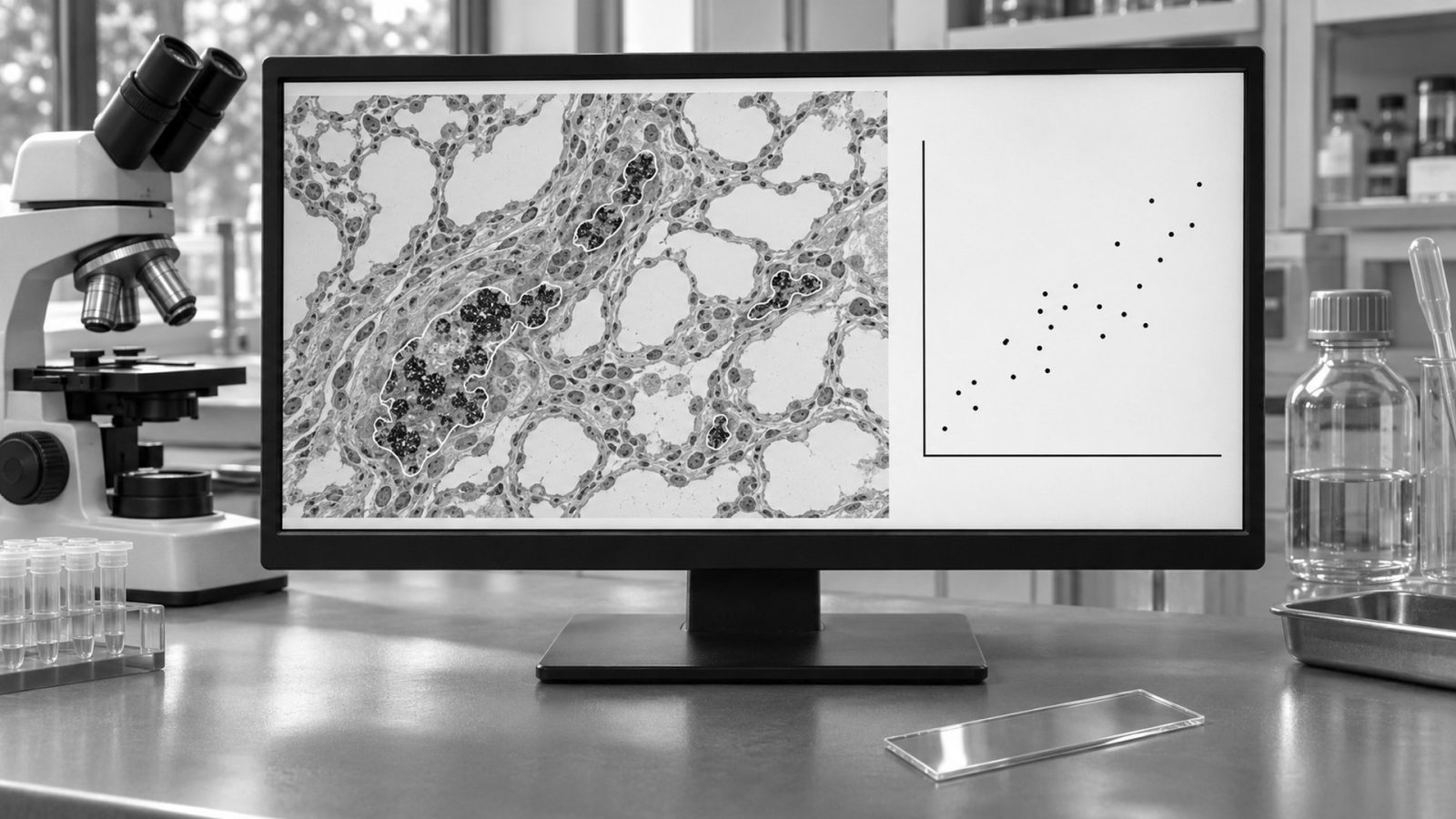
Fung et al., authors in Canada, developed an open-source, freely available automated image-analysis workflow. It applies pixel thresholds to scanned haematoxylin and eosin (H&E) slides and divides the area identified as black anthracotic pigment by the tissue area, expressing the result as a percentage. The study used one background non-neoplastic lung slide per patient from lung carcinoma resections in cohorts of 140 never-smoking patients and 59 ever-smoking patients. The Journal of Pathology: Clinical Research, July 2026
Across 10 synthetic test images, the workflow identified an average of 92.5% of the known pigment area with no false positive classifications. Its conservative thresholds under-detect very fine particles. Scanning artefacts such as dust, scratches, bubbles and dark borders meant that 19 slides in the never-smoking cohort needed a manually drawn tissue outline before analysis.
In the never-smoking cohort, scores ranged from 0.0029% to 0.37%, with a median of 0.033%. Older age correlated with more pigment (rank correlation R = 0.18). Male sex, higher 30-year residential fine-particle air pollution estimates and birth in Asia were also associated with higher scores when examined separately. Only age and birthplace remained significant in a multivariable regression model. The 3-year pollution estimates showed no significant association.
The comparison by smoking history found no statistically significant difference (p = 0.058). In an exploratory group of 15 patients, slide scores correlated with the expression of several inflammation-related genes measured in bronchoalveolar lavage cell blocks.
#Interpretation
On 10 real lung image patches, the workflow agreed with the rankings of four observers, including two pathologists. The average correlation was R = 0.864, close to the average between observers (R = 0.853). These figures describe agreement on the order of the patches by pigment burden. Absolute measurement accuracy in real tissue remains uncertain.
A slide-level pigment measure could add a tissue observation to research on air pollution and lung cancer in people who have never smoked, a question that matters in India too. Residential addresses are an imperfect proxy for personal exposure because they miss time spent elsewhere and can overlook indoor or occupational exposures. Each slide sampled one lobe per patient, so its score may give an incomplete picture of pigment burden across the lungs.
#Opinion
The main strength is the openness of the method. Other laboratories can inspect the thresholds and test the free workflow on their own slides. The authors calibrated the thresholds on slides from the same never-smoking cohort they later analysed, and scan quality affected how much manual input was needed. The authors describe the associations as hypothesis-generating.
#Limits
Few patients had high estimated pollution exposure, and the smoking comparison had low power to detect small differences. The result leaves open whether pigment burden differs by smoking history.
The gene-expression work used lavage cell blocks, separate samples from the slides scored for pigment. Slides in that group were scanned on a different scanner from the one used to set the thresholds. The authors caution that the gene-expression findings are exploratory and should not be considered definitive.
The abstract gives more weight to sex, long-term pollution and tumour morphology than the results support. The associations with sex and long-term pollution lost significance after adjustment, and the tumour morphology comparison did not reach statistical significance. The authors declared no conflicts of interest.
Frequently asked questions
When might a slide need manual outlining?
A slide may need manual outlining when scanning artefacts interfere with defining its tissue area. Dust, scratches, bubbles and dark borders caused this problem in the study. The authors drew tissue outlines by hand on affected slides before running the pigment analysis.
How much confidence does the observer comparison give in the score?
The observer comparison shows how well the workflow orders patches by pigment burden. On the real lung patches, agreement with the workflow was close to the agreement between observers. The actual percentage of pigment in those patches remains uncertain, particularly when deposits consist of very fine particles.
Can the pigment score tell me how much air pollution a person was exposed to?
The study does not establish the score as a measure of personal air pollution exposure. It used residential estimates, which can miss exposures away from home or indoors. The association with longer-term estimates lost significance after adjustment, and shorter-term estimates showed no statistically significant association.
Source
https://doi.org/10.1002/2056-4538.70110 ↗For education and professional reference. This does not give patient-specific advice or replace professional judgement, local protocols or consultation. Editorial standards.